Part one
The book
101 dinosaurs, three glowing plates each, every fact traced to its source.
Where others see a fossil, I see a spectrum.
Firoiu Dan Nicolae
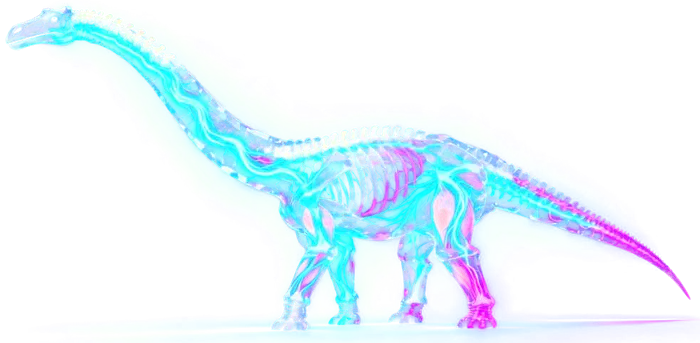
The dinosaurs as you have never seen them, and exactly as we know them
One hundred and one dinosaurs, each on its own spread. Beside every portrait: three facts, field notes, a timeline, a map of where the fossils lie, a danger gauge, and the animal set to scale beside a human being.
It runs from the first small hunters of the Triassic to the last giants of the Cretaceous, in five chapters, each opened by its own fossil motif: tracks, feathers, vertebrae and armour.
A book for families and young readers, and a gift to keep on the table.
- 0
Small Beginnings
The first dinosaurs and the smallest plant-eaters · 001 to 005
- I
Hunters
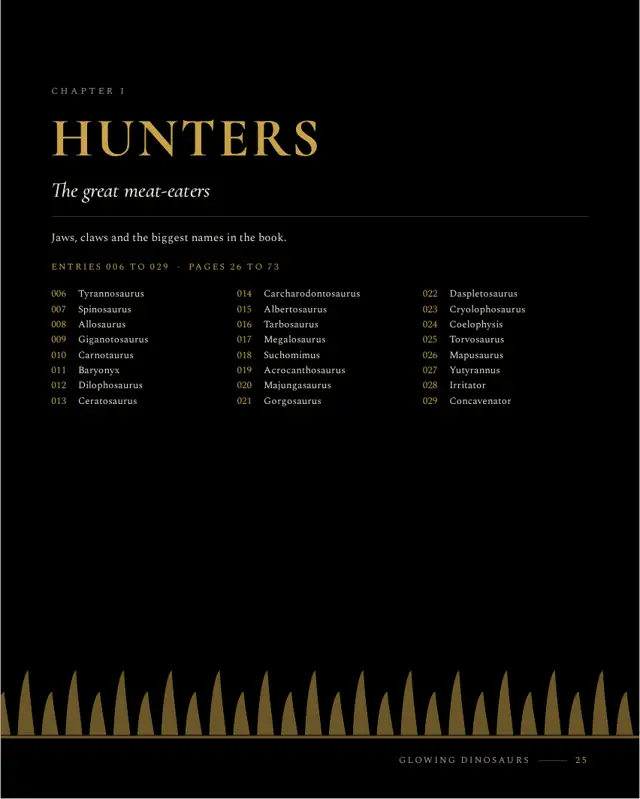
The great meat-eaters · 006 to 029
- II
Raptors and Feathers
Fast, feathered and clever · 030 to 053
- III
Giants
The biggest plant-eaters · 054 to 077
- IV
Horns and Armour
Tanks, spikes and frills · 078 to 101
Read the full story of the book
An atlas of the dinosaurs, drawn in light
Where others see a fossil, I see a spectrum.
Glowing Dinosaurs is the fourth volume of the Glowing Series, the illustrated atlases by the artist Firoiu Dan Nicolae. It gathers one hundred and one dinosaurs, from the first small hunters of the Triassic to the last giants of the Cretaceous, and shows each of them in the series’ own style: a body of glass lit from within, with bone, muscle and nerve glowing in neon colour against pure black.
The pictures are art, and the book says so plainly. Everything printed beside them is natural history. Every dinosaur has its own spread of two pages: a text page with three short facts, a column of field notes, a timeline across the last 539 million years, a map of where its fossils were found, a size panel with a person 1.8 metres tall, and a gauge that answers the question every child asks first, which is how dangerous it would have been had we met. On the facing page stands the animal itself, whole, at the size of the page.
Each animal has three plates: the whole body, a portrait at the head of the text page, and a side view set to scale. That makes 303 plates in a book of about 240 pages, printed at 24 by 30 centimetres, a size made to be opened on a table and shared.
The book is arranged in five parts. A prologue, Small Beginnings, opens with the first dinosaurs and the smallest plant-eaters. Then come four chapters: Hunters, the great meat-eaters; Raptors and Feathers, the dinosaurs that became birds; Giants, the largest animals ever to walk; and Horns and Armour, the plant-eaters built to fight back. Each chapter is announced by its own fossil motif: a trackway of three-toed footprints, a row of teeth, a scatter of feathers, a line of vertebrae and a field of armour scales.
Behind the spectacle is a careful method. Every fact is tied to a scientific paper, a museum or a book, and the sources are listed at the back by entry number. Where scientists disagree, the page shows both sides. Where a fact rests only on a later account, the list says so. Before the book is printed, a specialist reads the whole text.
The book is also the start of an exhibition. Its plates can be printed on wood or acrylic under glass and hung on a single gallery wall, built into a darkened room around a great lightbox, spread through a hall as a walk through deep time, or fixed to the buildings of a whole town. Alongside them can stand eight fluorescent animatronic dinosaurs that glow under ultraviolet light and move.
On these pages you can look inside the finished spreads, read how the facts are checked, see how the exhibition grows from one wall to a city, meet the companion volume Most Dangerous Dinosaurs and the author, and reserve a copy.
How the atlas is built
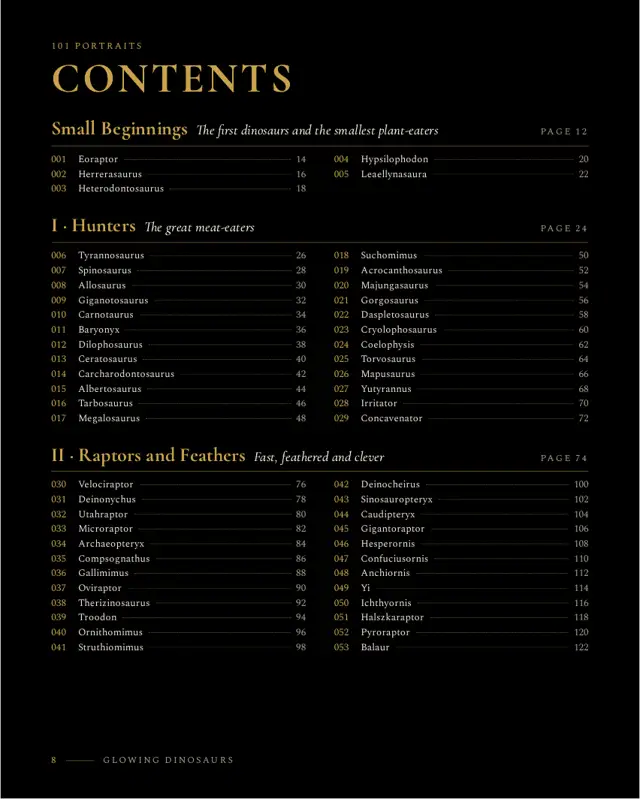
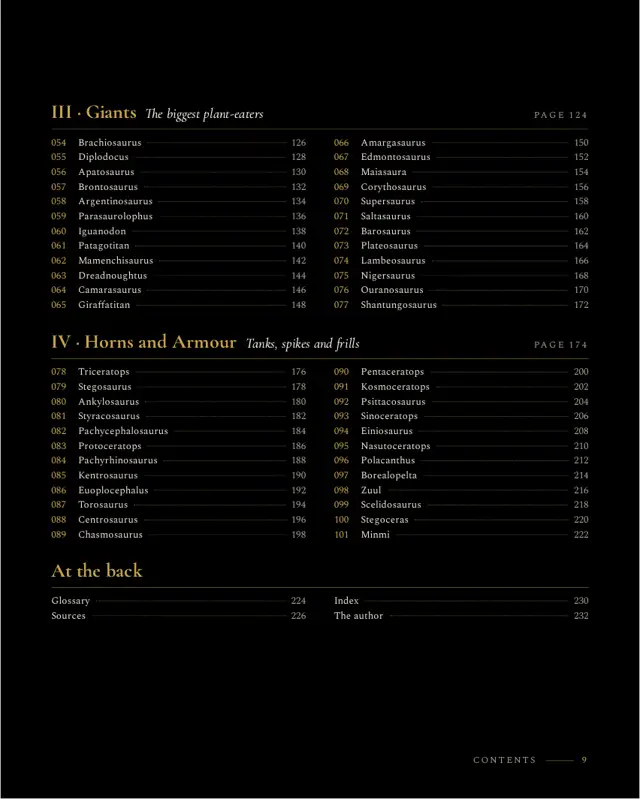
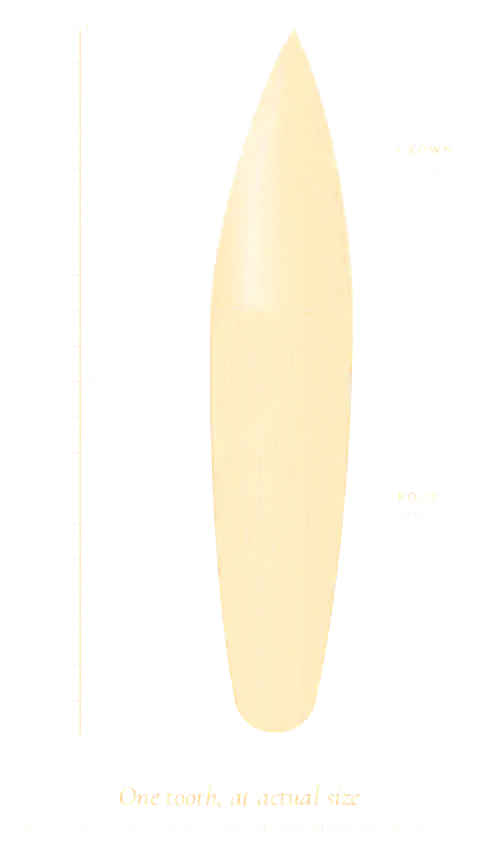
Glowing Dinosaurs follows the frame of the Glowing Series: dark pages, gold type and one animal to a spread. It opens with a short sequence before the first dinosaur. After the cover and the copyright page comes the epigraph, Where others see a fossil, I see a spectrum. Then two pages print a fossil at its true size. The first is a Tyrannosaurus tooth, crown and root, beside a ruler marked to twenty centimetres. The second is a three-toed footprint of the kind called Grallator, left by a small meat-eater much like Coelophysis. After the title page and the dedication, the contents set out all 101 portraits on a single spread, numbered and grouped by chapter.
The entries follow in five parts. The prologue, Small Beginnings, holds five animals: two of the earliest dinosaurs known and three little plant-eaters that lived in the shadow of the great ones. Chapter I, Hunters, holds twenty-four meat-eaters, from Tyrannosaurus and Spinosaurus to Concavenator. Chapter II, Raptors and Feathers, holds twenty-four dinosaurs that became birds, the first birds themselves and their sharp-clawed cousins. Chapter III, Giants, holds twenty-four of the biggest plant-eaters, with their long necks and duck bills. Chapter IV, Horns and Armour, holds twenty-four plant-eaters built to fight back.
What every spread holds
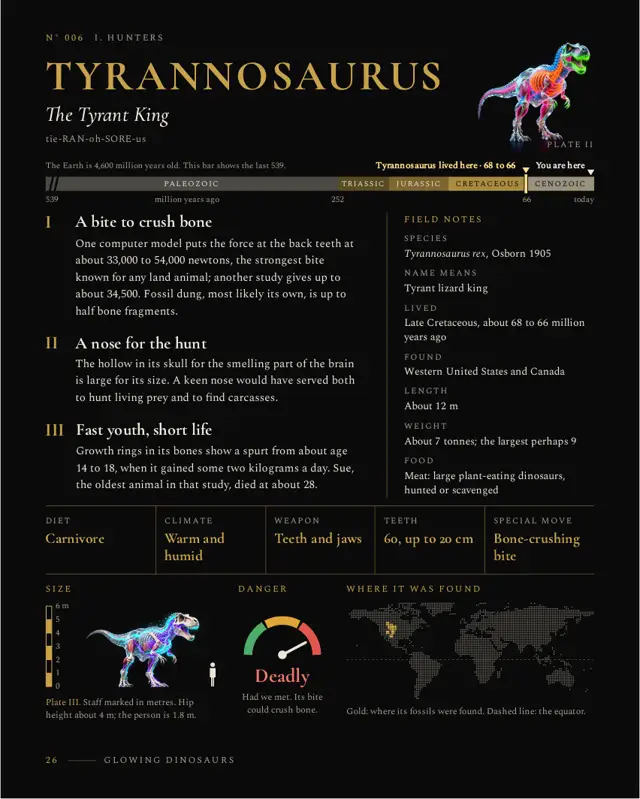
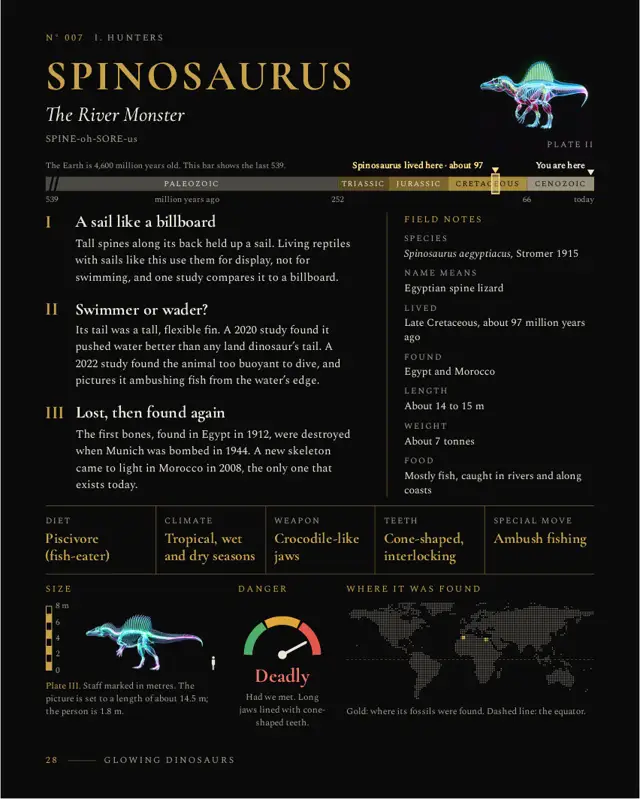
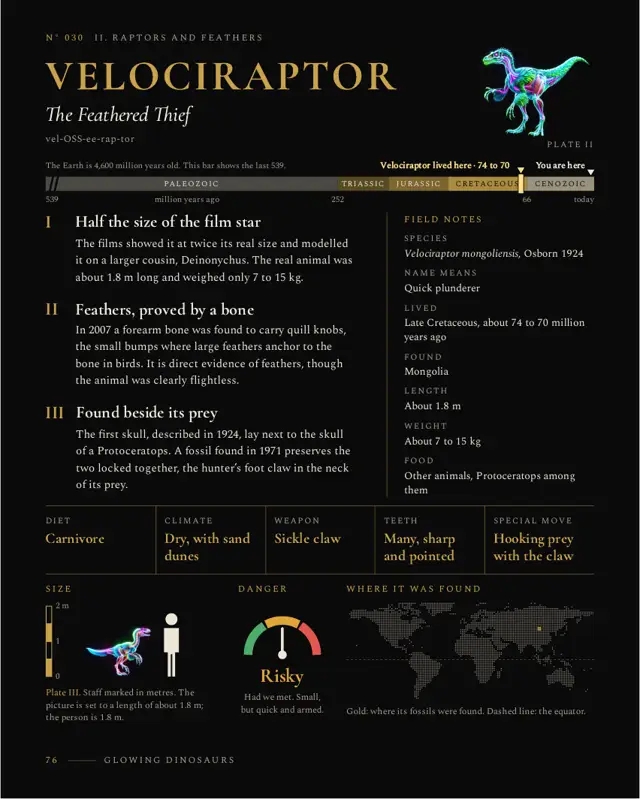
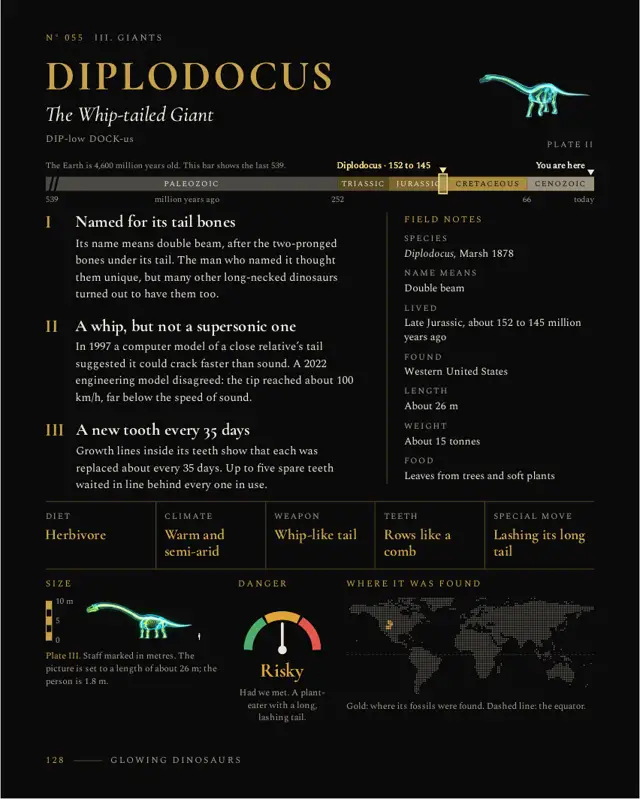
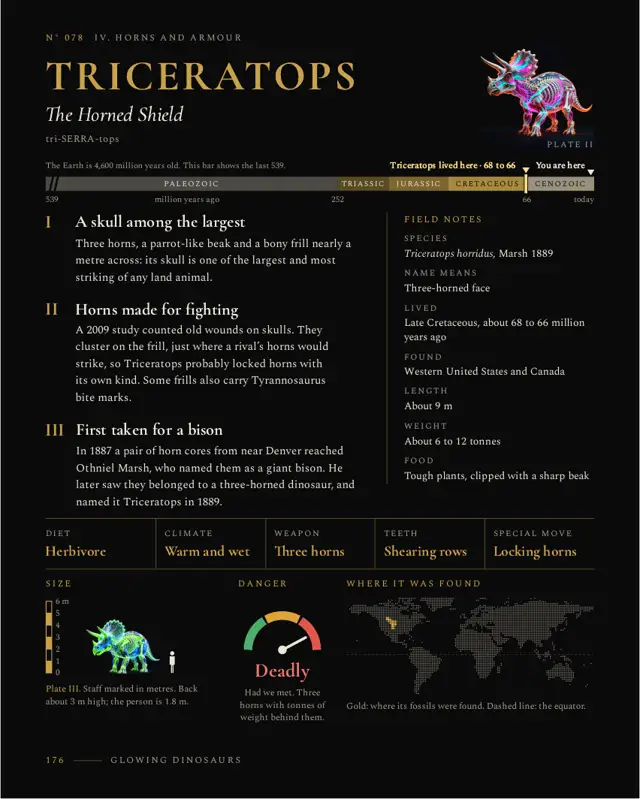
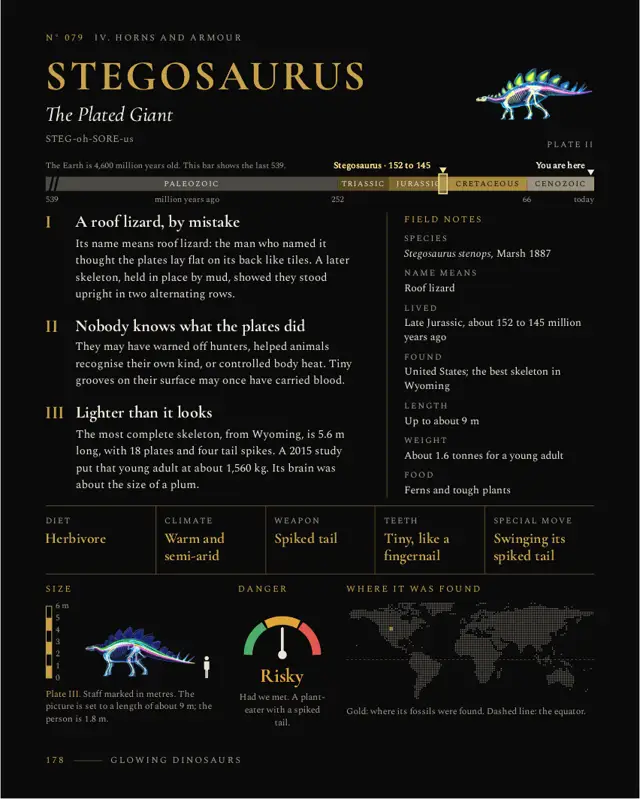
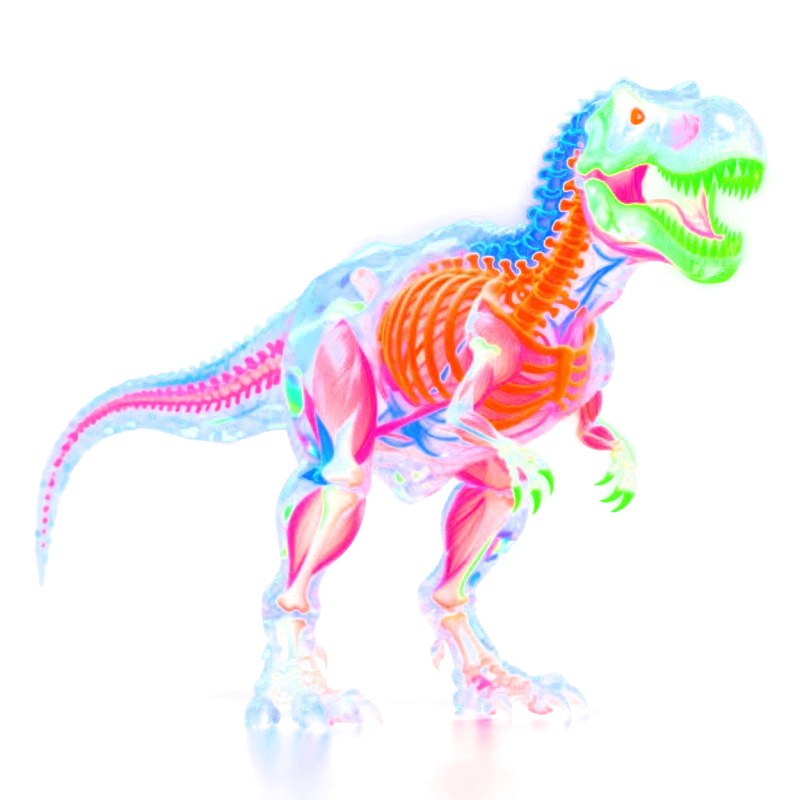
The left-hand page is the text page. At the top stand the entry number, the chapter, the genus name in large gold capitals, a short epithet such as The Treetop Giant or The Feathered Thief, and a line on how to say the name. Beside them sits Plate II, a small portrait of the animal.
Below runs a timeline. It shows the last 539 million years, marks the Paleozoic, the Triassic, the Jurassic, the Cretaceous and the Cenozoic, and points to the moment the animal lived and to the present day, so a reader can see at once how far back it stands.
Then come three facts, each a short paragraph with its own title, chosen to surprise and written to be read aloud. Beside them, the field notes give the species and who named it, what the name means, when the animal lived, where it was found, its length, its weight and its food. A strip of five traits follows: diet, climate, weapon, teeth and special move.
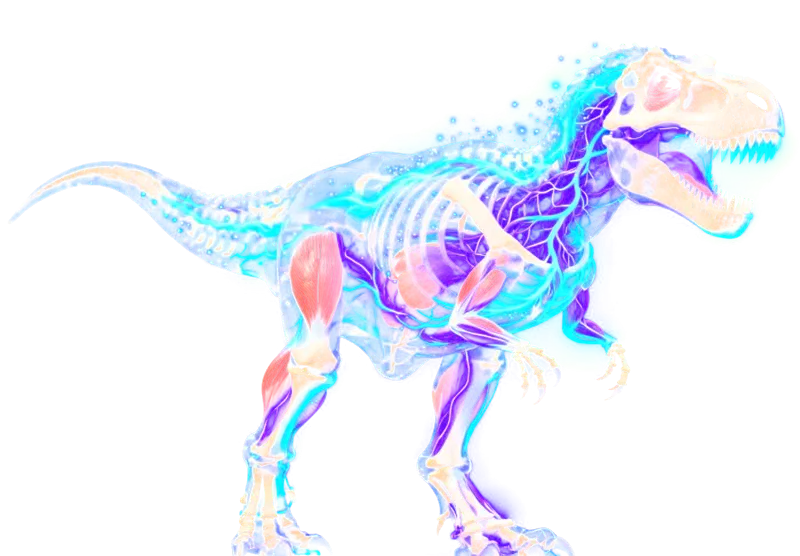
At the foot of the page are three panels. The size panel sets Plate III, a level side view, beside a person 1.8 metres tall on a staff marked in metres. The danger gauge rates the animal harmless, risky or deadly, had we met, with a line of explanation. The map shows today’s world in fine dots, with gold where the fossils were found and a dashed line for the equator.
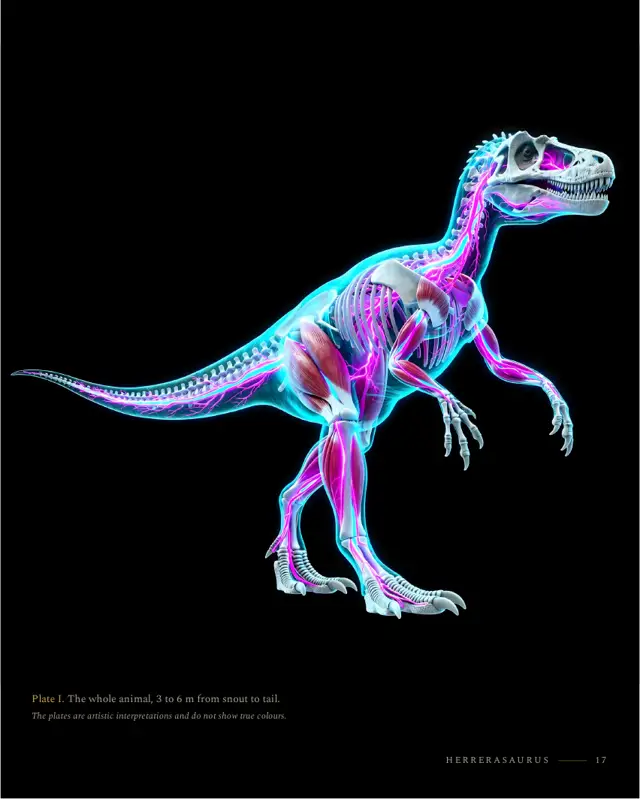
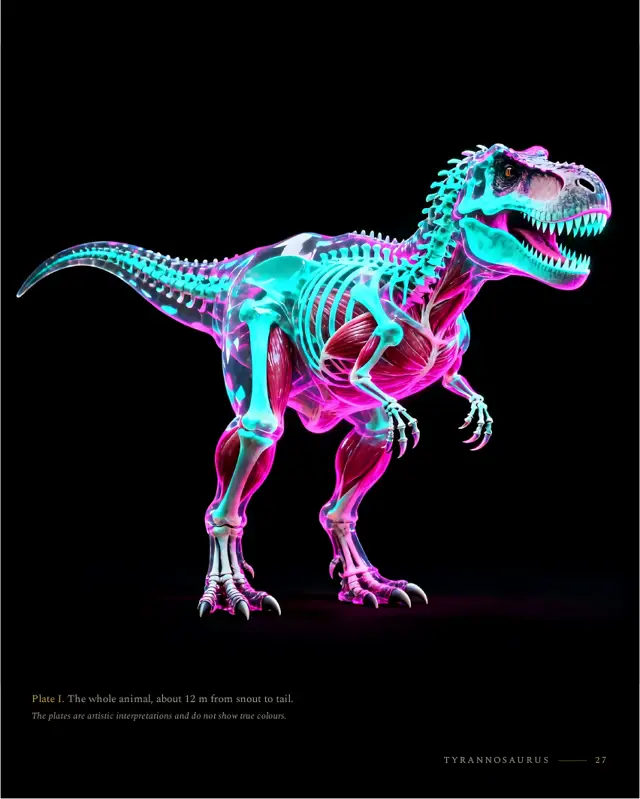
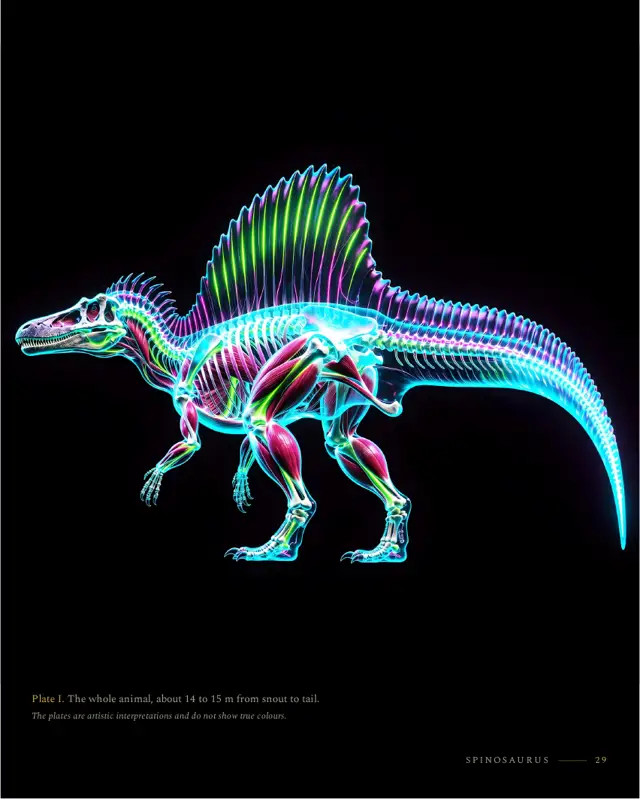
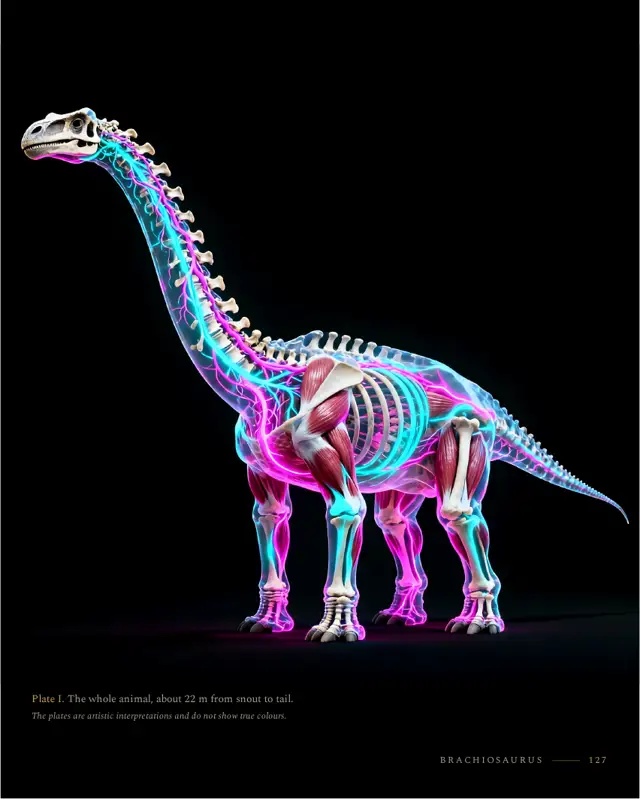
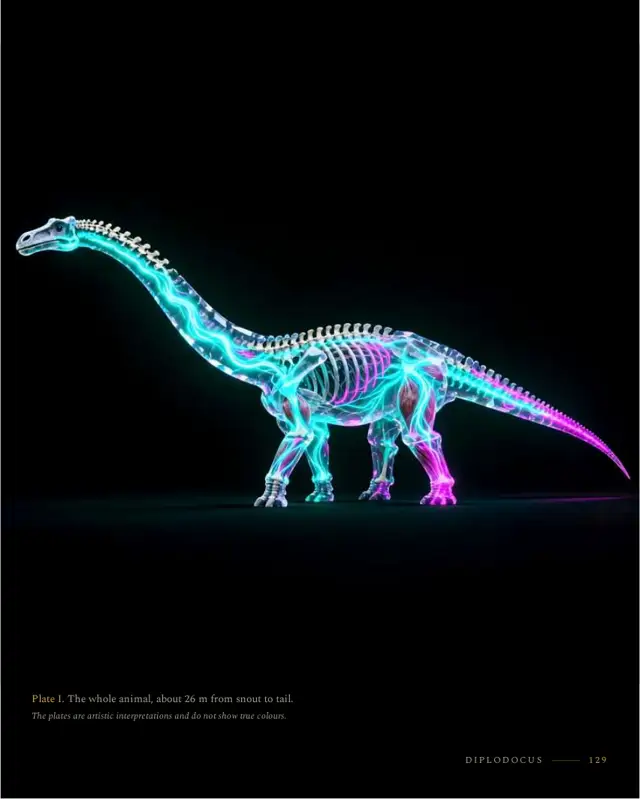
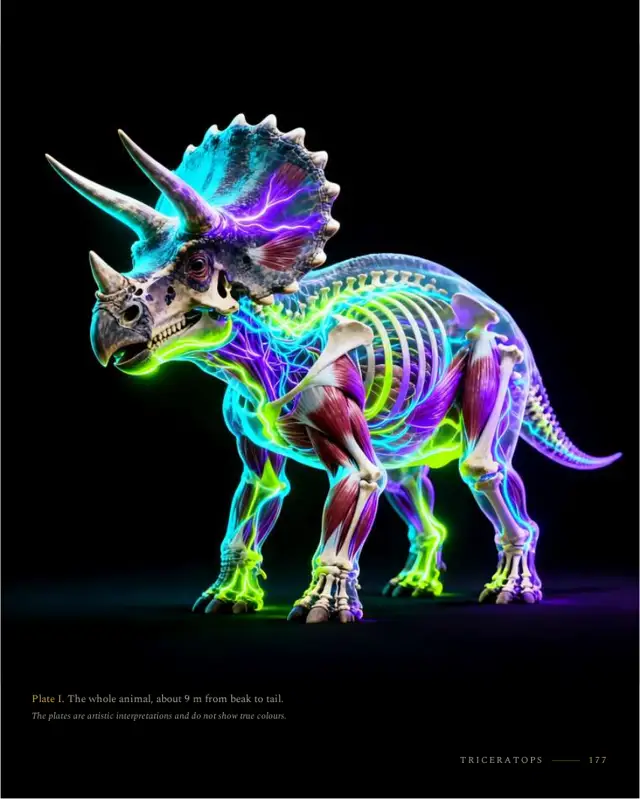
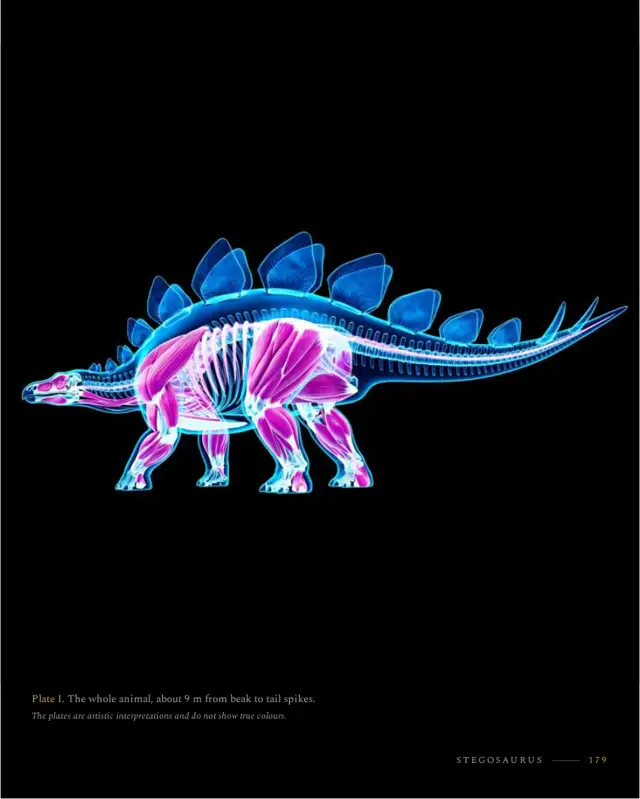
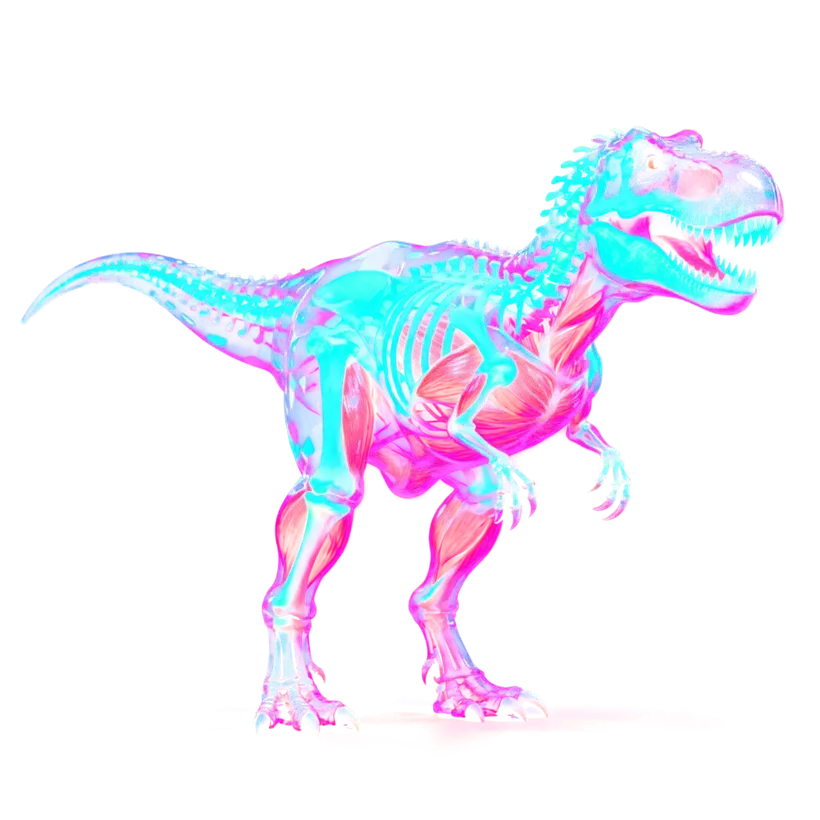
The right-hand page belongs to Plate I: the whole animal, glowing on black, with a caption giving its length and a reminder that the plates are artistic interpretations and do not show true colours.
At the back are a glossary, the sources listed by entry, an index of common and scientific names, and a page on the author.
A work of art that can be trusted
The light is the artist’s. The science is not.
No dinosaur is known to have glowed: the light is art, and the animals are real. Every fact is traced to the paper or museum it rests on, and where scientists disagree, the page says so. Before print, a specialist reads the whole text.
Number, name and epithet
N° 001 to 101, the genus name with how to say it, and a short title such as The Treetop Giant.
Three facts
Three short paragraphs, each with its source noted as it is written.
Field notes
Species and who named it, meaning of the name, when it lived, where it was found, length, weight and food.
A strip of traits
Diet, climate, weapon, teeth and special move, at a glance.
A map of the fossils
Gold marks where the bones were found, on today’s map.
Size and danger
The animal beside a person 1.8 m tall, and a gauge for how dangerous it would have been.
Why a book of light needs sources
Why a book of light needs a list of sources
The plates in Glowing Dinosaurs are openly artistic. No dinosaur is known to have glowed, and the colours shown are not true colours, except where an entry says the colour is known from the fossil. Because the pictures take that freedom, the words beside them take none. Every name, date, length, weight and story printed on a spread rests on a source that a reader can look up.
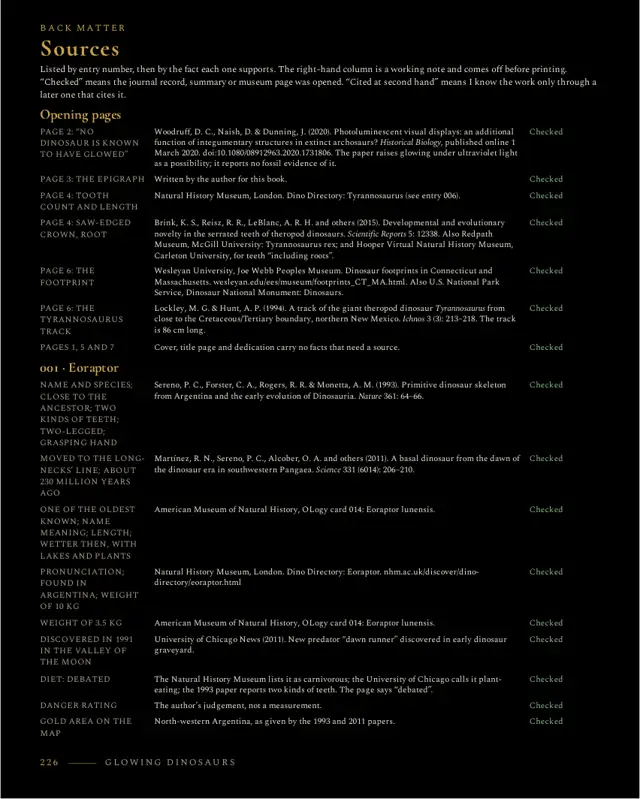
The sources are written down while the text is written, not afterwards. Each fact gets its paper, museum page or book at the moment it goes onto the page. At the back of the book they are listed by entry number, then by the fact each one supports, so a teacher, a parent or a curious reader can go straight from a sentence to the work behind it.
What “checked” means
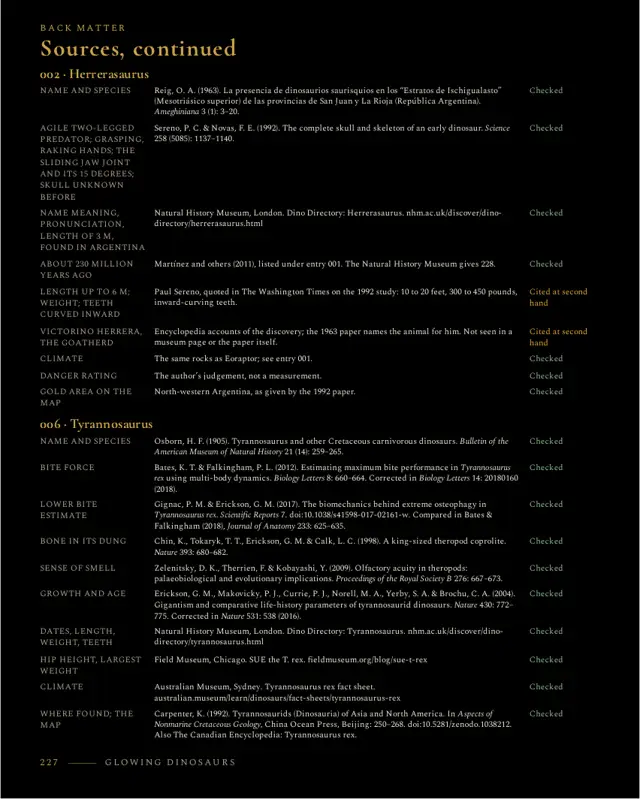
During the work, every source row carries a note. Checked means the journal record, the published summary or the museum page was opened and read. Cited at second hand means the work is known only through a later one that cites it. That second label is used honestly: in the finished entries so far, two facts carry it, and they are marked as such. These working notes come off before printing, but the standard stays.
Most rows point to primary research in journals such as Nature, Science, PLoS ONE, Biology Letters and Scientific Reports, or to the pages of great natural history museums: the Natural History Museum in London, the American Museum of Natural History and the Field Museum in Chicago among them. The timeline on every spread follows the International Chronostratigraphic Chart of the International Commission on Stratigraphy, and the coastlines on the maps are drawn from the GLOBE land and sea data set.
Where scientists disagree, the page says so
Many of the best stories in palaeontology are arguments, and the book tells them as arguments. A 2001 computer study proposed that Allosaurus struck its prey with its upper jaw like a hatchet; other scientists replied that its strong skull suited holding struggling prey, and the page gives both views. A 1997 model suggested a long-necked dinosaur’s tail could crack faster than sound; a 2022 engineering model found the tip reached about 100 kilometres an hour. A 2020 study found that Spinosaurus’s tail pushed water better than any land dinosaur’s; a 2022 study found the animal too buoyant to dive. Even Eoraptor’s diet is printed as debated, because the sources disagree.
Some things on a spread are not facts at all, and the book is clear about which. The epithets, such as The Tyrant King, and the danger ratings are the author’s judgement, not measurements, and the sources say so in their own rows.
The question of glowing itself is treated the same way. A 2020 paper in Historical Biology raised the possibility that some extinct animals glowed under ultraviolet light, but it reports no fossil evidence of it. So the book states the plain position on its copyright page: the light is the artist’s; the animals are real.
Before printing, a specialist reads the whole text, corrections are made, and the reviewer is named in the book.
Turn the pages
Every dinosaur has two facing pages: what is known on the left, the full plate on the right. Spreads from the book as it stands today: eleven finished animals, a chapter opener, the contents and the sources. Swipe through.
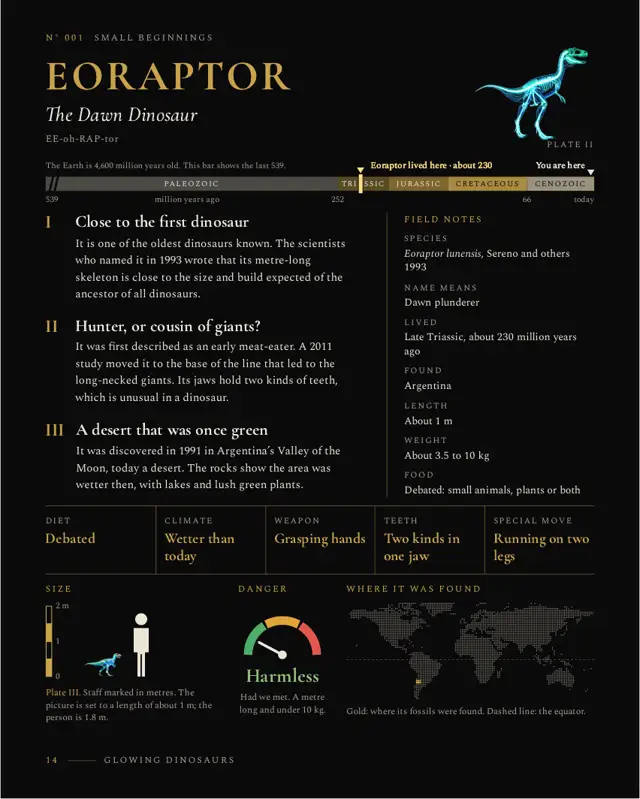
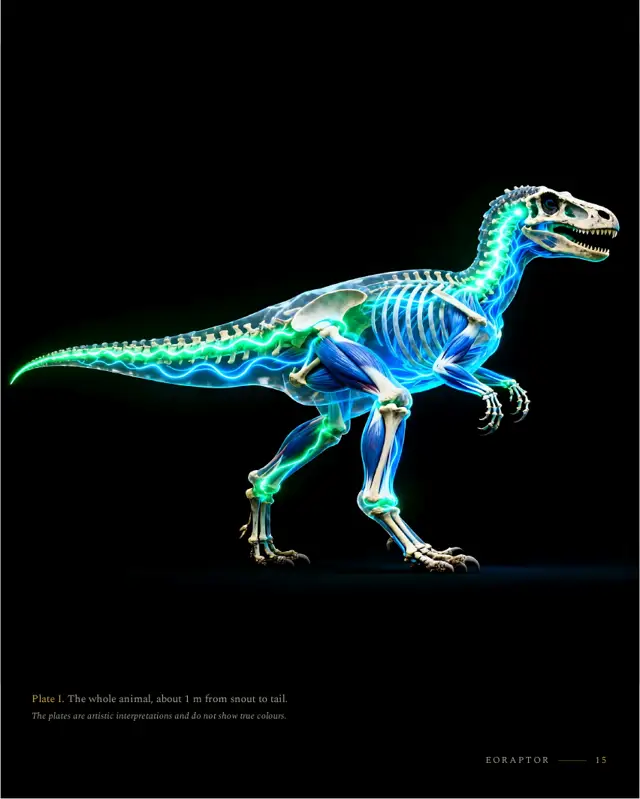
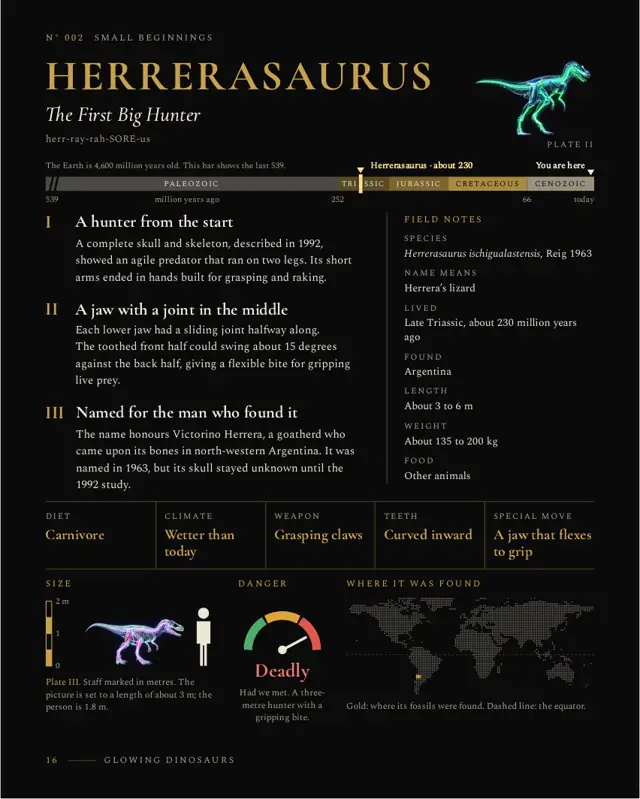
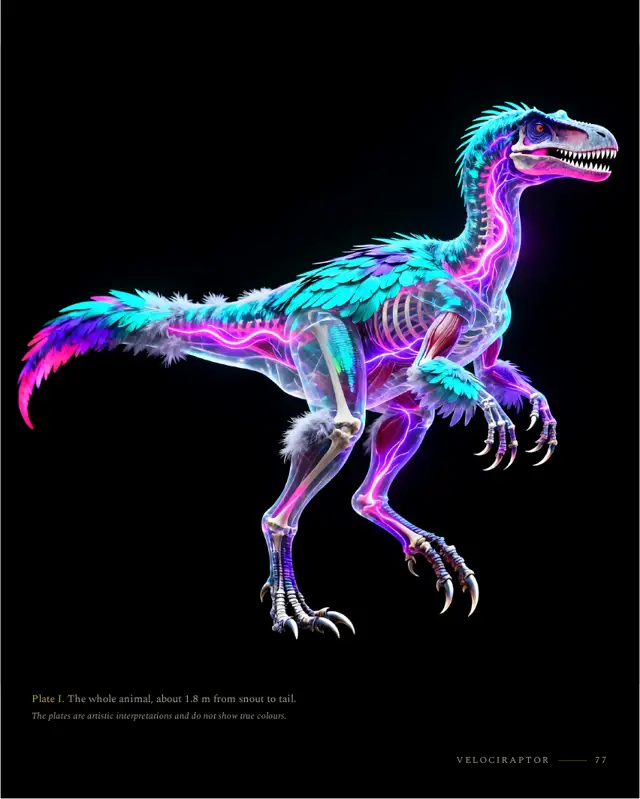
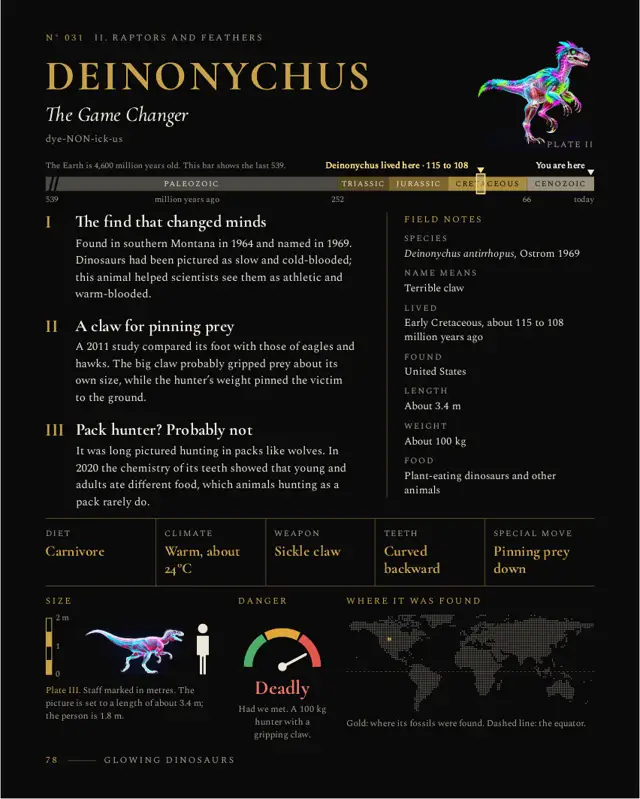
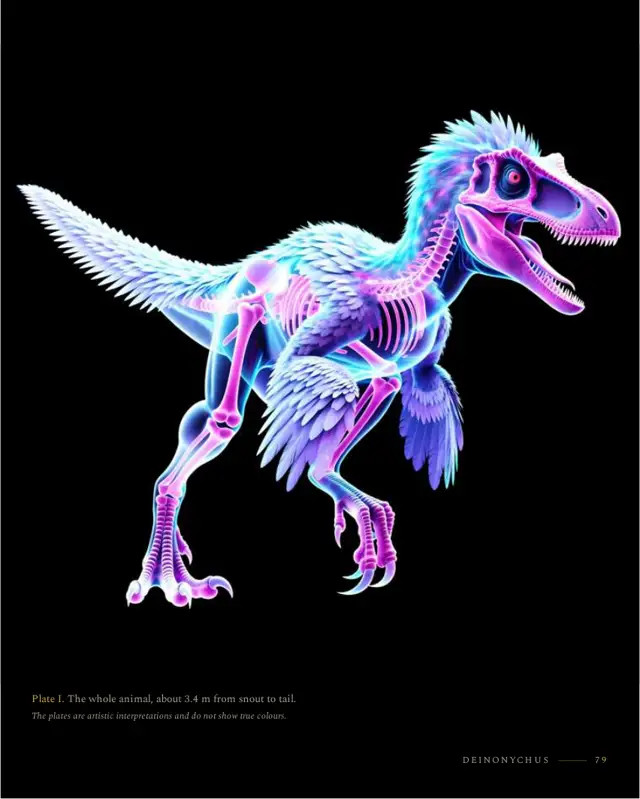
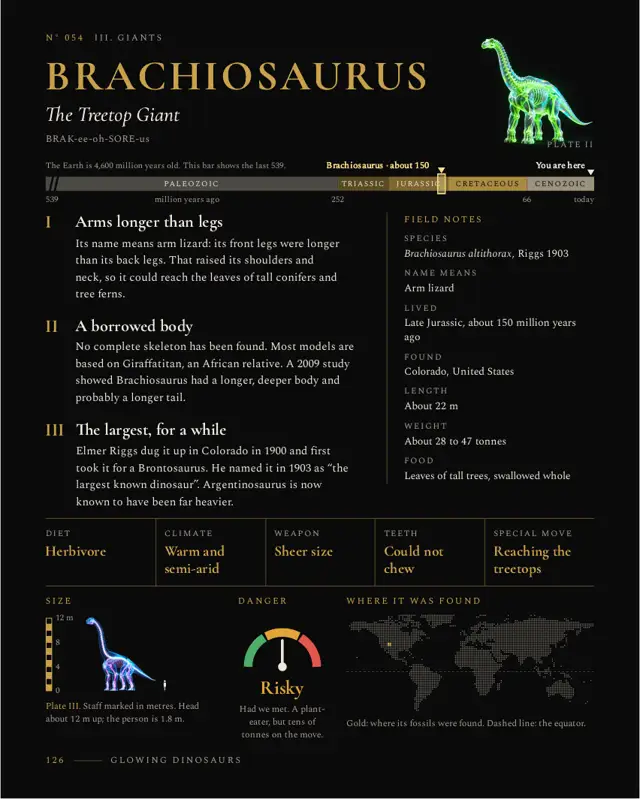
On every spread
The six signs
Six panels, the same on every dinosaur, let even a young reader compare one with another at a glance. These are the real panels from the book, from entry N° 006, Tyrannosaurus.

Timeline
When it lived, marked on a bar across the last 539 million years, next to the present day.
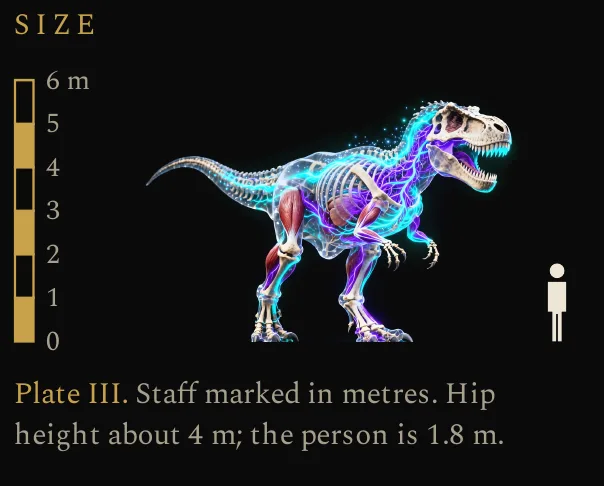
Size
The animal set to scale beside a person 1.8 metres tall, on a staff marked in metres.
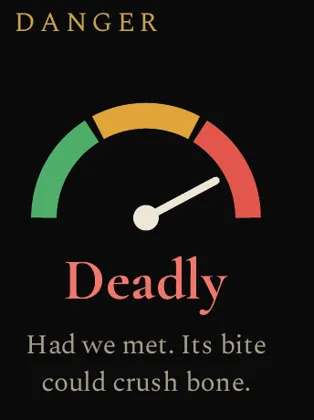
Danger
A gauge from harmless to risky to deadly, had we met, with the reason why.
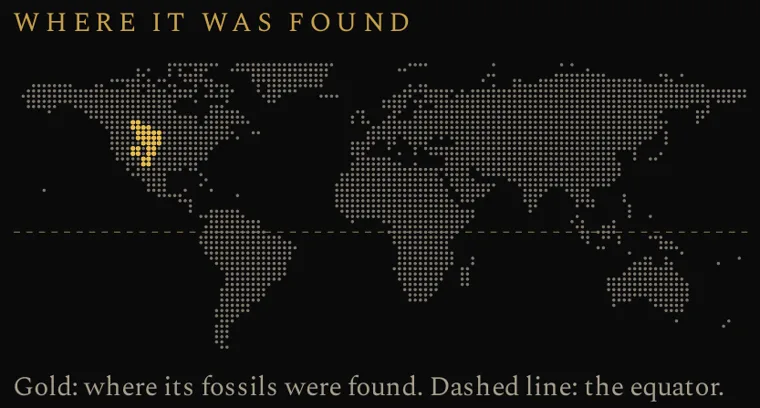
Where it was found
Gold on a world map where its fossils were dug from the ground.
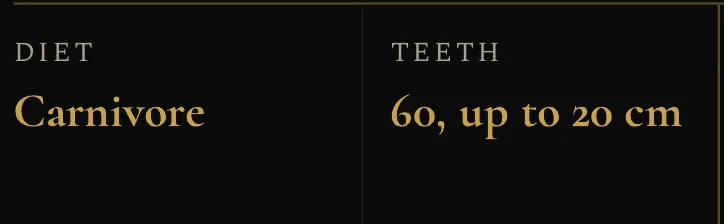
Diet and teeth
What it ate, and the teeth it ate with.
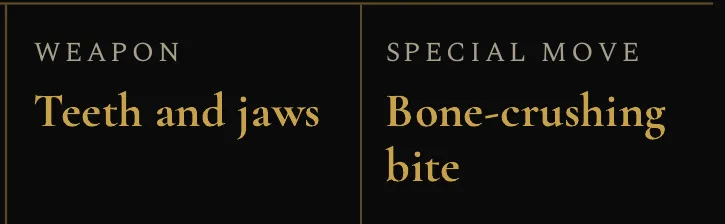
Weapon and special move
Its weapon, and the move it was built for.
How the book was checked
At the back, every fact on every page is listed by entry with the paper, museum page or book it comes from: Nature, Science, PLoS ONE, Biology Letters, the Natural History Museum in London, the American Museum of Natural History and the Field Museum among them. Where a fact rests only on a later account, the list says so, and where scientists disagree, the page shows both sides.
The glowing gallery
Plate I of ten finished entries. Tap one to read the facts and field notes printed beside it.
Every animal, three ways
Each of the 101 has three plates: the whole animal on the right-hand page, a portrait at the top of the text page, and a side view set to scale beside a person. Here are Tyrannosaurus’s three.
Two things at actual size
The book is built to be held. Before the first animal, two pages print a fossil at its true size, so a reader can lay a hand beside it.
Get the book
Three ways to own Glowing Dinosaurs
The atlas
The full atlas: 101 dinosaurs, 303 glowing plates, three facts, field notes and six signs on every dinosaur. 24 × 30 cm, about 240 pages.
Price to be announced
Reserve a copyA signed copy
The atlas, signed by the artist. A gift for anyone who loves dinosaurs, science or art.
Price to be announced
Reserve a signed copyCollector’s editions
Plates of the book at 60 or 100 cm on wood or acrylic under glass: unique works and editions of ten and twenty-five.
On request
See the editionsBookshops, museum shops and publishers: write to us for trade terms, translation and co-edition rights. Reserve now and we will write to you with the price and release date before anything is charged. When you write to us we use your details only to answer you: see our privacy policy.
Privacy policy · GDPR
How we handle your personal data
Last updated 28 October 2026
Who is responsible
The controller of your personal data is CocoAgency EOOD (Coco Agency), represented by Firoiu Dan Nicolae, Lavele 18A, apt. 8, Sofia, Bulgaria, company number (EIK) 202075523, VAT number BG202075523. You can reach us at dan@cocoagency.bg or +359 87 612 8527.
What this website does not do
This website has no user accounts, no forms that store your data, no advertising, no analytics and no tracking cookies. We do not sell or rent personal data to anyone.
What we collect, and why
When you write to us. The buttons “Reserve a copy”, “Ask for trade terms”, “Ask for dates”, “Enquire privately” and similar open your own email program. When you send that email we receive your email address, your name if you give it, and whatever you write. We use it only to answer you and to deal with your request: a reservation, a trade, rights or exhibition enquiry, or a question.
Legal bases. For reservations, trade, publishing and exhibition enquiries: steps taken at your request before a possible contract (Article 6(1)(b) GDPR). For other messages: our legitimate interest in answering people who contact us (Article 6(1)(f)). Where we must keep records by law, such as invoices: a legal obligation (Article 6(1)(c)).
Settings on your own device. If you switch on the jungle sound, the website remembers that choice in your browser’s local storage, on your device only. It is not sent to us and is not used to identify you. You can clear it at any time in your browser settings.
Technical data. To show the page, your browser connects to our hosting provider, which necessarily receives technical data such as your IP address and browser type, and keeps it in short-lived server logs for security. The typefaces are served from this website itself; no data is sent to Google or any other font service.
Who else receives your data
Only the providers we need: our email provider and the hosting provider described above, and, if you go on to order or work with us, our accountants, couriers or printers as needed for that order. Some of these providers may process data outside the European Economic Area; where they do, the transfer relies on the safeguards they offer, such as the European Commission’s standard contractual clauses or the EU-US Data Privacy Framework.
How long we keep it
Emails are kept for as long as needed to deal with your request and then for up to 24 months after our last contact, so that we can follow up on the same matter. If a contract follows, records are kept for as long as Bulgarian law requires, for example accounting records. Reservations that do not lead to an order are deleted once the book is released or when you ask us.
Your rights
You can ask us at any time to access your data, correct it, delete it, restrict or object to its use, or receive it in a portable format. Where we rely on your consent, you can withdraw it at any time. Write to dan@cocoagency.bg; we answer within one month.
You also have the right to complain to the Bulgarian supervisory authority, the Commission for Personal Data Protection (www.cpdp.bg), or to the authority in the EU country where you live.
Children
The book is made for families, but this website does not knowingly collect data from children. If you are under 14, please ask a parent or guardian to write to us for you.
Changes
We may update this policy when the website or the law changes. The date at the top shows the latest version.
Terms and conditions
Terms of use of this website
Last updated 28 October 2026
1. About us
This website is operated by CocoAgency EOOD (Coco Agency), represented by Firoiu Dan Nicolae, Lavele 18A, apt. 8, Sofia, Bulgaria, company number (EIK) 202075523, VAT number BG202075523. Contact: dan@cocoagency.bg, +359 87 612 8527.
2. What the website is for
The website presents the book Glowing Dinosaurs: An Atlas of Glowing Ancient Forms, its companion volume, the Glowing Dinosaurs exhibition, the collector’s editions and the artist. By using it you accept these terms.
3. Reservations are not orders
Reserving a copy, a signed copy or a collector’s edition is a free, non-binding expression of interest. No payment is taken and no contract is formed. Before any sale we will tell you the price, the delivery terms, your right of withdrawal and all other information required by law, and a contract is formed only when you confirm the order. Prices and release dates are not yet set.
4. Exhibitions, animatronics and proposals
The exhibition designs, floor plans, visualisations and formats shown are proposals. Visualisations are not photographs of finished works. Formats marked as proposals are developed and costed with each venue; nothing on this website is a binding offer. Any exhibition, hire of the animatronic dinosaurs, edition or publishing agreement is governed by a separate written contract.
5. The pictures and the facts
The plates are artistic interpretations and do not show the true colours of the animals. No dinosaur is known to have glowed. The facts in the book are traced to published sources, but science changes; we do our best to keep the information accurate and current, and we welcome corrections.
6. Copyright and use of the content
All plates, illustrations, texts, page designs, videos, sound and other content on this website are protected by copyright and belong to Firoiu Dan Nicolae or are used with permission. You may view the website and share links to it. You may not copy, download, reproduce, print, adapt, sell or use any plate or other content, including for training artificial intelligence, without our written permission. For press, education or partnership use, write to us.
Glowing Oceans, Glowing Bugs, Glowing Dinosaurs, Most Dangerous Bugs, Most Dangerous Dinosaurs and the Glowing Series are titles of the artist’s work.
7. Downloads
The sample of the book and the trailer are offered for personal viewing and for assessing the book or the exhibition. They may be shared with colleagues for that purpose, but not published or altered.
8. Availability and liability
The website is provided as it is. We do not guarantee that it will always be available or free of errors. To the extent permitted by law, we are not liable for any loss arising from the use of the website. Nothing in these terms limits liability that cannot be limited by law, or your rights as a consumer.
9. Links
Links to other websites are provided for convenience. We are not responsible for their content or their privacy practices.
10. Law and disputes
These terms are governed by Bulgarian law. Disputes go to the competent courts in Sofia, Bulgaria, without affecting the mandatory consumer protection of the country where you live. Consumers in the EU can also use the European Commission’s online dispute resolution platform.
11. Changes
We may update these terms. The date at the top shows the latest version.