The atlas
The 101 dinosaurs
From the first small hunters of the Triassic to the last giants of the Cretaceous.
Finished so far
Meet the dinosaurs
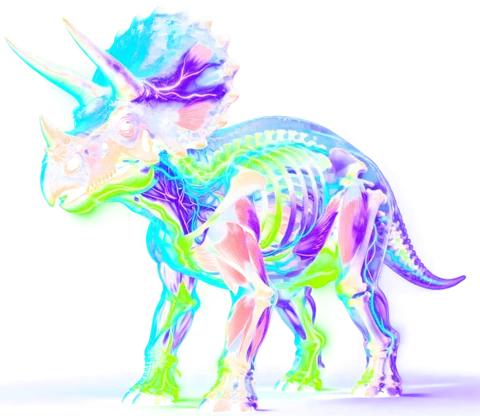
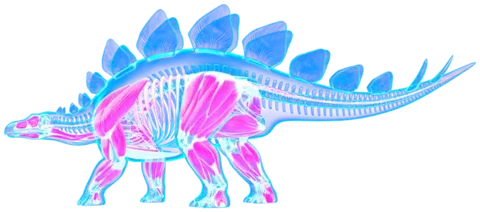
Each animal has its own spread in the book: three facts, field notes, its six signs and three glowing plates. These are the first to be finished, shown by chapter; the rest follow as the atlas is completed.
Small Beginnings
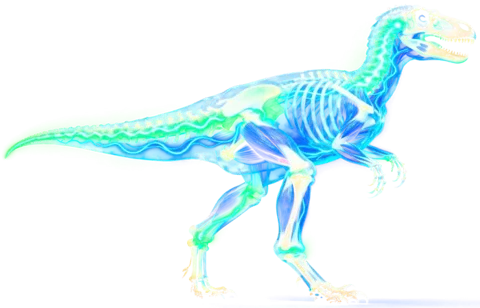
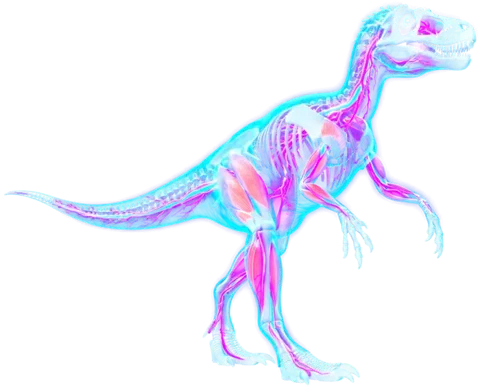
I. Hunters
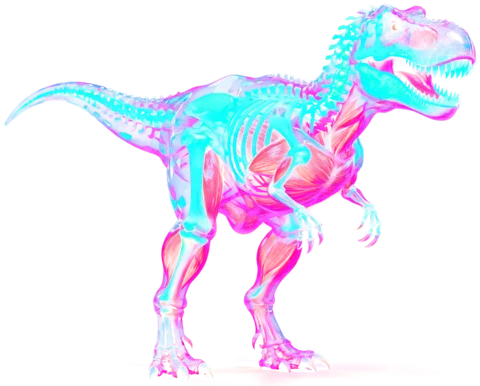
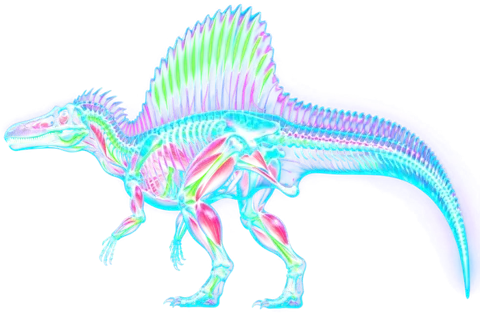
II. Raptors and Feathers
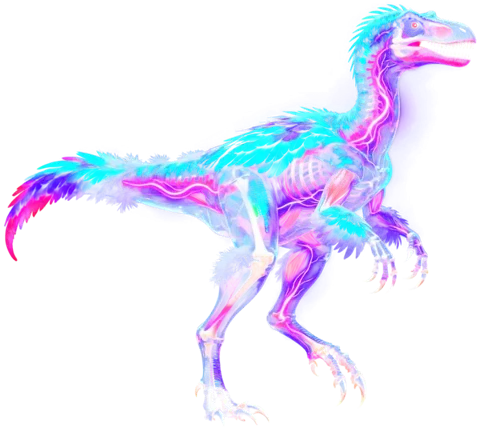
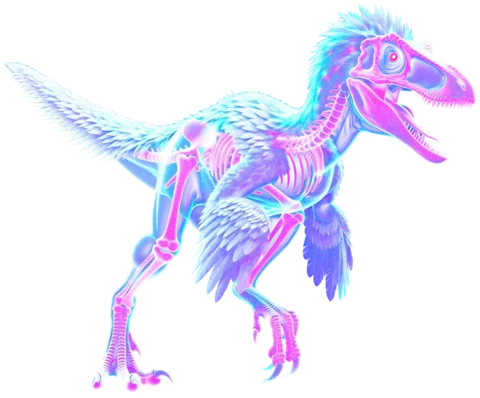
III. Giants
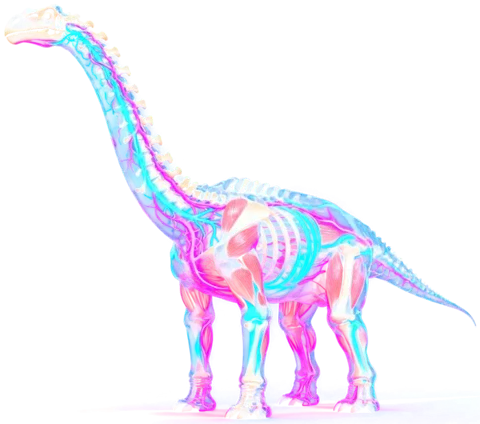
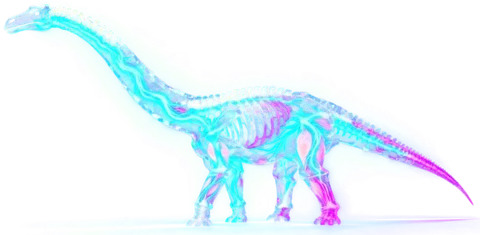
IV. Horns and Armour
Where they stand in deep time
Every entry carries a timeline. Here ten finished animals stand by when they lived, from about 230 million years ago to the end of the age of dinosaurs, 66 million years ago.
The 101
Every dinosaur in the book, by chapter. Names in gold have a finished page you can open here.
How the atlas is organised
Glowing Dinosaurs: An Atlas of Glowing Ancient Forms holds 101 dinosaurs, each numbered from N° 001 to N° 101 and grouped into chapters by the kind of animal it was. The book opens with the small beginnings of the Triassic, the first dinosaurs from more than 230 million years ago, and moves through the great hunters, the raptors and feathered dinosaurs, the long-necked giants, and the horned and armoured plant-eaters. Each chapter can be read on its own, so a reader who loves the giants can go straight to them, while the numbering keeps the whole atlas in order.
Every dinosaur is given the same treatment. On the left-hand page stand its number, its name and how to say it, a short epithet such as The Feathered Thief or The Treetop Giant, three facts, field notes and the six signs: when it lived, how big it was, how dangerous it would have been, where its fossils were found, what it ate and how it fought. On the right-hand page is the full glowing plate. Two more plates of each animal appear elsewhere in the book, making 303 in all.
Three periods, 186 million years
The dinosaurs in the atlas span the whole Mesozoic era. The Triassic, from about 252 to 201 million years ago, saw the first dinosaurs appear as small, quick animals in a world ruled by other reptiles. In the Jurassic, from about 201 to 145 million years ago, they became the largest animals on land, among them the long-necked giants such as Brachiosaurus and Diplodocus and the plated Stegosaurus. The Cretaceous, from about 145 to 66 million years ago, brought feathered raptors, horned dinosaurs and the last great hunters, ending with the asteroid impact that wiped out every dinosaur except the birds.
Checked against the sources
Every fact in the atlas is traced to a published scientific source, and the sources are listed at the back of the book. Where scientists still disagree, as they do about how Spinosaurus lived or whether Deinonychus hunted in packs, the atlas says so plainly rather than choosing the most exciting answer. The glowing colours are the only invention: no dinosaur is known to have glowed, and the light is the artist’s way of showing bone, muscle and form.
How to read a dinosaur page
Each finished dinosaur has its own page on this site, built like its spread in the book. At the top is the glowing plate, with the entry number, the chapter, the name, the epithet and how to say it, followed by the field notes: the full scientific name, what the name means, when and where it lived, its length, its weight and its diet. Below come the three facts from the book, a longer account of when and where it lived, how it was discovered and how it lived, and answers to the questions readers ask most often. Links at the bottom lead to related dinosaurs, so you can follow a chapter or an era from one animal to the next.
More to come
The dinosaurs above are the first to be finished. The rest of the 101 are being drawn, written and checked one by one, and each will receive its own page here as it is completed. To hear when the book is ready, reserve a copy without obligation.
Privacy policy · GDPR
How we handle your personal data
Last updated 28 October 2026
Who is responsible
The controller of your personal data is CocoAgency EOOD (Coco Agency), represented by Firoiu Dan Nicolae, Lavele 18A, apt. 8, Sofia, Bulgaria, company number (EIK) 202075523, VAT number BG202075523. You can reach us at dan@cocoagency.bg or +359 87 612 8527.
What this website does not do
This website has no user accounts, no forms that store your data, no advertising, no analytics and no tracking cookies. We do not sell or rent personal data to anyone.
What we collect, and why
When you write to us. The buttons “Reserve a copy”, “Ask for trade terms”, “Ask for dates”, “Enquire privately” and similar open your own email program. When you send that email we receive your email address, your name if you give it, and whatever you write. We use it only to answer you and to deal with your request: a reservation, a trade, rights or exhibition enquiry, or a question.
Legal bases. For reservations, trade, publishing and exhibition enquiries: steps taken at your request before a possible contract (Article 6(1)(b) GDPR). For other messages: our legitimate interest in answering people who contact us (Article 6(1)(f)). Where we must keep records by law, such as invoices: a legal obligation (Article 6(1)(c)).
Settings on your own device. If you switch on the jungle sound, the website remembers that choice in your browser’s local storage, on your device only. It is not sent to us and is not used to identify you. You can clear it at any time in your browser settings.
Technical data. To show the page, your browser connects to our hosting provider, which necessarily receives technical data such as your IP address and browser type, and keeps it in short-lived server logs for security. The typefaces are served from this website itself; no data is sent to Google or any other font service.
Who else receives your data
Only the providers we need: our email provider and the hosting provider described above, and, if you go on to order or work with us, our accountants, couriers or printers as needed for that order. Some of these providers may process data outside the European Economic Area; where they do, the transfer relies on the safeguards they offer, such as the European Commission’s standard contractual clauses or the EU-US Data Privacy Framework.
How long we keep it
Emails are kept for as long as needed to deal with your request and then for up to 24 months after our last contact, so that we can follow up on the same matter. If a contract follows, records are kept for as long as Bulgarian law requires, for example accounting records. Reservations that do not lead to an order are deleted once the book is released or when you ask us.
Your rights
You can ask us at any time to access your data, correct it, delete it, restrict or object to its use, or receive it in a portable format. Where we rely on your consent, you can withdraw it at any time. Write to dan@cocoagency.bg; we answer within one month.
You also have the right to complain to the Bulgarian supervisory authority, the Commission for Personal Data Protection (www.cpdp.bg), or to the authority in the EU country where you live.
Children
The book is made for families, but this website does not knowingly collect data from children. If you are under 14, please ask a parent or guardian to write to us for you.
Changes
We may update this policy when the website or the law changes. The date at the top shows the latest version.
Terms and conditions
Terms of use of this website
Last updated 28 October 2026
1. About us
This website is operated by CocoAgency EOOD (Coco Agency), represented by Firoiu Dan Nicolae, Lavele 18A, apt. 8, Sofia, Bulgaria, company number (EIK) 202075523, VAT number BG202075523. Contact: dan@cocoagency.bg, +359 87 612 8527.
2. What the website is for
The website presents the book Glowing Dinosaurs: An Atlas of Glowing Ancient Forms, its companion volume, the Glowing Dinosaurs exhibition, the collector’s editions and the artist. By using it you accept these terms.
3. Reservations are not orders
Reserving a copy, a signed copy or a collector’s edition is a free, non-binding expression of interest. No payment is taken and no contract is formed. Before any sale we will tell you the price, the delivery terms, your right of withdrawal and all other information required by law, and a contract is formed only when you confirm the order. Prices and release dates are not yet set.
4. Exhibitions, animatronics and proposals
The exhibition designs, floor plans, visualisations and formats shown are proposals. Visualisations are not photographs of finished works. Formats marked as proposals are developed and costed with each venue; nothing on this website is a binding offer. Any exhibition, hire of the animatronic dinosaurs, edition or publishing agreement is governed by a separate written contract.
5. The pictures and the facts
The plates are artistic interpretations and do not show the true colours of the animals. No dinosaur is known to have glowed. The facts in the book are traced to published sources, but science changes; we do our best to keep the information accurate and current, and we welcome corrections.
6. Copyright and use of the content
All plates, illustrations, texts, page designs, videos, sound and other content on this website are protected by copyright and belong to Firoiu Dan Nicolae or are used with permission. You may view the website and share links to it. You may not copy, download, reproduce, print, adapt, sell or use any plate or other content, including for training artificial intelligence, without our written permission. For press, education or partnership use, write to us.
Glowing Oceans, Glowing Bugs, Glowing Dinosaurs, Most Dangerous Bugs, Most Dangerous Dinosaurs and the Glowing Series are titles of the artist’s work.
7. Downloads
The sample of the book and the trailer are offered for personal viewing and for assessing the book or the exhibition. They may be shared with colleagues for that purpose, but not published or altered.
8. Availability and liability
The website is provided as it is. We do not guarantee that it will always be available or free of errors. To the extent permitted by law, we are not liable for any loss arising from the use of the website. Nothing in these terms limits liability that cannot be limited by law, or your rights as a consumer.
9. Links
Links to other websites are provided for convenience. We are not responsible for their content or their privacy practices.
10. Law and disputes
These terms are governed by Bulgarian law. Disputes go to the competent courts in Sofia, Bulgaria, without affecting the mandatory consumer protection of the country where you live. Consumers in the EU can also use the European Commission’s online dispute resolution platform.
11. Changes
We may update these terms. The date at the top shows the latest version.