N° 031 · II. Raptors and Feathers
Deinonychus
The Game Changer
Say it: dye-NON-ick-us
- Species
- Deinonychus antirrhopus, Ostrom 1969
- Name means
- Terrible claw
- Lived
- Early Cretaceous, about 115 to 108 million years ago
- Found
- United States
- Length
- About 3.4 m
- Weight
- About 100 kg
- Diet
- Carnivore
Three things to know
The find that changed minds
Found in Montana in 1964 and named in 1969, it helped scientists see dinosaurs as athletic and warm-blooded rather than slow and cold-blooded.
A claw for pinning prey
A 2011 study compared its foot with those of eagles and hawks. The big claw probably gripped prey while the hunter’s weight pinned it down.
Pack hunter? Probably not
In 2020 the chemistry of its teeth showed that young and adults ate different food, which animals hunting as a pack rarely do.
Every fact on this page is traced to a published source, listed at the back of the book.
When and where Deinonychus lived
Deinonychus lived about 115 to 108 million years ago, in the Early Cretaceous, in what is now the western United States. Its fossils come mostly from the Cloverly Formation of Montana and Wyoming, which records river plains with forests of conifers, ferns and early flowering plants. Its remains are often found alongside those of Tenontosaurus, a large plant-eating dinosaur that may have been among its prey.
How Deinonychus was discovered and named
A team led by John Ostrom and Grant Meyer of Yale University found the first good skeletons in Montana in 1964, and Ostrom named Deinonychus, the terrible claw, in 1969. His description of a fast, agile and bird-like hunter started what became known as the dinosaur renaissance, a new view of dinosaurs as active animals, and revived the idea that birds are living dinosaurs.
How Deinonychus lived
Deinonychus was about three metres long, with a long, stiffened tail, grasping arms that carried feathers, and a large sickle-shaped claw on each foot. Like modern birds of prey, it probably used that claw to pin its victim down while it fed. The raptors of the Jurassic Park films were modelled largely on Deinonychus, even though they were given the name of its smaller Asian cousin.
Deinonychus in Glowing Dinosaurs
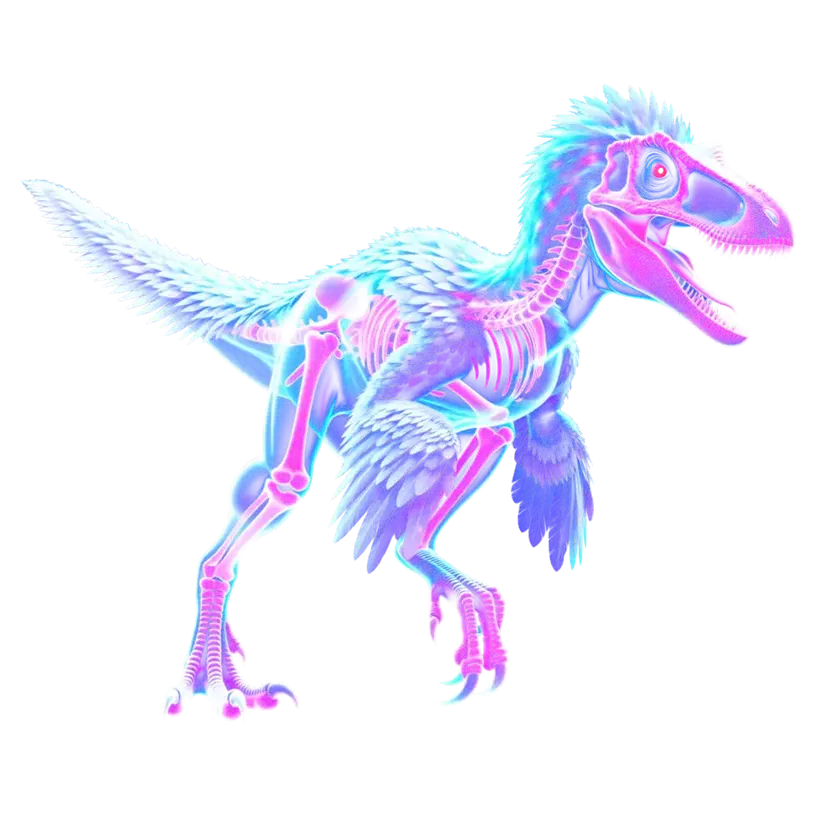
Deinonychus is entry N° 031 of the atlas, in the chapter II. Raptors and Feathers. Its spread follows the same layout as every other dinosaur in the book: on the left, its name and how to say it, the epithet The Game Changer, the three facts above, field notes and the six signs that show when it lived, how big it was, how dangerous it would have been, where it was found, what it ate and how it fought. On the right is the full glowing plate: feathered Deinonychus in purple and pink, running, with wing feathers on its arms. Two more plates of Deinonychus appear elsewhere in the book, and each can also be ordered as a signed work for the wall, printed on wood or acrylic under glass. In the same chapter you will also find Velociraptor.
Why Deinonychus glows
No dinosaur is known to have glowed, and the book says so plainly. The light is the artist’s way of seeing inside the animal: in the plate of Deinonychus, bones, muscles and outline shine through a dark ground, so the shape of the skull, the length of the neck and tail and the build of the legs can be read at once, the way a fossil skeleton is read in a museum hall. The colours are chosen to separate bone from muscle and to make each animal recognisable across the whole atlas, while every fact printed beside the picture is checked against published research.
Questions about Deinonychus
How big was Deinonychus?
Deinonychus measured about 3.4 m from nose to tail and weighed about 100 kg. The size panel on its spread in the book draws it beside a person, so its scale can be seen at a glance.
When did Deinonychus live?
It lived in the Early Cretaceous, about 115 to 108 million years ago. On the timeline in the book, its place is marked between the first dinosaurs, about 230 million years ago, and the end of the age of dinosaurs, 66 million years ago.
Where have Deinonychus fossils been found?
Its fossils have been found in United States. The map on its spread in the book marks the places where its bones were dug up.
What did Deinonychus eat?
Its diet: carnivore. The diet sign in the book shows this with a simple symbol, so young readers can sort the plant-eaters from the meat-eaters.
What does the name Deinonychus mean?
The name means “terrible claw”. The full scientific name is Deinonychus antirrhopus, Ostrom 1969: the genus, the species and the scientist who named it, with the year. It is pronounced dye-NON-ick-us.
Privacy policy · GDPR
How we handle your personal data
Last updated 28 October 2026
Who is responsible
The controller of your personal data is CocoAgency EOOD (Coco Agency), represented by Firoiu Dan Nicolae, Lavele 18A, apt. 8, Sofia, Bulgaria, company number (EIK) 202075523, VAT number BG202075523. You can reach us at dan@cocoagency.bg or +359 87 612 8527.
What this website does not do
This website has no user accounts, no forms that store your data, no advertising, no analytics and no tracking cookies. We do not sell or rent personal data to anyone.
What we collect, and why
When you write to us. The buttons “Reserve a copy”, “Ask for trade terms”, “Ask for dates”, “Enquire privately” and similar open your own email program. When you send that email we receive your email address, your name if you give it, and whatever you write. We use it only to answer you and to deal with your request: a reservation, a trade, rights or exhibition enquiry, or a question.
Legal bases. For reservations, trade, publishing and exhibition enquiries: steps taken at your request before a possible contract (Article 6(1)(b) GDPR). For other messages: our legitimate interest in answering people who contact us (Article 6(1)(f)). Where we must keep records by law, such as invoices: a legal obligation (Article 6(1)(c)).
Settings on your own device. If you switch on the jungle sound, the website remembers that choice in your browser’s local storage, on your device only. It is not sent to us and is not used to identify you. You can clear it at any time in your browser settings.
Technical data. To show the page, your browser connects to our hosting provider, which necessarily receives technical data such as your IP address and browser type, and keeps it in short-lived server logs for security. The typefaces are served from this website itself; no data is sent to Google or any other font service.
Who else receives your data
Only the providers we need: our email provider and the hosting provider described above, and, if you go on to order or work with us, our accountants, couriers or printers as needed for that order. Some of these providers may process data outside the European Economic Area; where they do, the transfer relies on the safeguards they offer, such as the European Commission’s standard contractual clauses or the EU-US Data Privacy Framework.
How long we keep it
Emails are kept for as long as needed to deal with your request and then for up to 24 months after our last contact, so that we can follow up on the same matter. If a contract follows, records are kept for as long as Bulgarian law requires, for example accounting records. Reservations that do not lead to an order are deleted once the book is released or when you ask us.
Your rights
You can ask us at any time to access your data, correct it, delete it, restrict or object to its use, or receive it in a portable format. Where we rely on your consent, you can withdraw it at any time. Write to dan@cocoagency.bg; we answer within one month.
You also have the right to complain to the Bulgarian supervisory authority, the Commission for Personal Data Protection (www.cpdp.bg), or to the authority in the EU country where you live.
Children
The book is made for families, but this website does not knowingly collect data from children. If you are under 14, please ask a parent or guardian to write to us for you.
Changes
We may update this policy when the website or the law changes. The date at the top shows the latest version.
Terms and conditions
Terms of use of this website
Last updated 28 October 2026
1. About us
This website is operated by CocoAgency EOOD (Coco Agency), represented by Firoiu Dan Nicolae, Lavele 18A, apt. 8, Sofia, Bulgaria, company number (EIK) 202075523, VAT number BG202075523. Contact: dan@cocoagency.bg, +359 87 612 8527.
2. What the website is for
The website presents the book Glowing Dinosaurs: An Atlas of Glowing Ancient Forms, its companion volume, the Glowing Dinosaurs exhibition, the collector’s editions and the artist. By using it you accept these terms.
3. Reservations are not orders
Reserving a copy, a signed copy or a collector’s edition is a free, non-binding expression of interest. No payment is taken and no contract is formed. Before any sale we will tell you the price, the delivery terms, your right of withdrawal and all other information required by law, and a contract is formed only when you confirm the order. Prices and release dates are not yet set.
4. Exhibitions, animatronics and proposals
The exhibition designs, floor plans, visualisations and formats shown are proposals. Visualisations are not photographs of finished works. Formats marked as proposals are developed and costed with each venue; nothing on this website is a binding offer. Any exhibition, hire of the animatronic dinosaurs, edition or publishing agreement is governed by a separate written contract.
5. The pictures and the facts
The plates are artistic interpretations and do not show the true colours of the animals. No dinosaur is known to have glowed. The facts in the book are traced to published sources, but science changes; we do our best to keep the information accurate and current, and we welcome corrections.
6. Copyright and use of the content
All plates, illustrations, texts, page designs, videos, sound and other content on this website are protected by copyright and belong to Firoiu Dan Nicolae or are used with permission. You may view the website and share links to it. You may not copy, download, reproduce, print, adapt, sell or use any plate or other content, including for training artificial intelligence, without our written permission. For press, education or partnership use, write to us.
Glowing Oceans, Glowing Bugs, Glowing Dinosaurs, Most Dangerous Bugs, Most Dangerous Dinosaurs and the Glowing Series are titles of the artist’s work.
7. Downloads
The sample of the book and the trailer are offered for personal viewing and for assessing the book or the exhibition. They may be shared with colleagues for that purpose, but not published or altered.
8. Availability and liability
The website is provided as it is. We do not guarantee that it will always be available or free of errors. To the extent permitted by law, we are not liable for any loss arising from the use of the website. Nothing in these terms limits liability that cannot be limited by law, or your rights as a consumer.
9. Links
Links to other websites are provided for convenience. We are not responsible for their content or their privacy practices.
10. Law and disputes
These terms are governed by Bulgarian law. Disputes go to the competent courts in Sofia, Bulgaria, without affecting the mandatory consumer protection of the country where you live. Consumers in the EU can also use the European Commission’s online dispute resolution platform.
11. Changes
We may update these terms. The date at the top shows the latest version.